... growing and hybridizing all kinds of plants in zone 6b Maryland since the 1980's.

Saturday, November 22, 2014

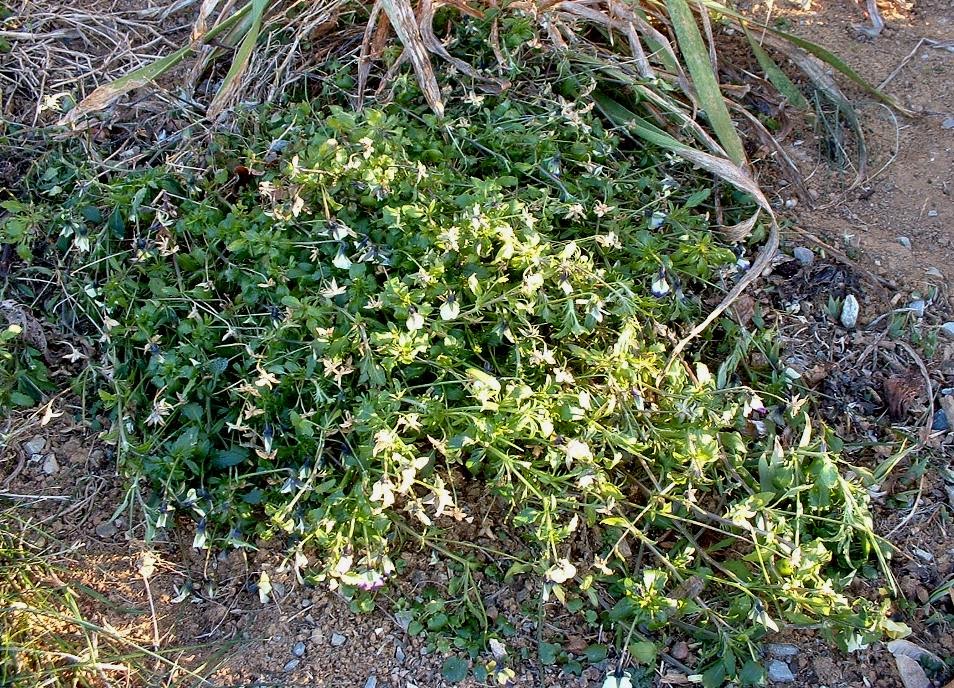
Viola arvensis X pansy

Last year's F1 seedlings from Viola arvensis X red pansy, not only made it through last winter with all the "polar vortex" craziness, but they also survived the summer heat which is even more unusual for pansies around here. Here's the clump of F1 seedlings at 21°F this morning - frozen solid.

 
 And here's a close up of a flowering shoot so you can see the "frozen spinach" look of the foliage. I don't know exactly just how cold it's been so far for sure, but I know it's at least been down to 16°F within the past week and blooms were still looking fresh and undamaged when the temperatures warmed back up afterwards.

 
Here's that same shoot close up later in the day when the temperature went above freezing again. The ground is still frozen underneath the surface, so I think it's having a hard time sending water up to the thawed out parts, but even so looks pretty unfazed. I'll try to get another picture once it's been above freezing long enough to thaw the ground too.

Monday, September 1, 2014

Some rose species hybrids

Well the Rosa palustris X fedtschenkoana  F1 has pretty much defoliated from blackspot, I guess. It'll still be fun to see it bloom next year (hopefully) but it doesn't look like a winner for disease resistance by any means.
 In contrast, these new Rosa davidii X fedtschenkoana are looking incredibly healthy. One is showing mildew (and might get culled because of that) but the rest are looking great. I don't see much if any signs of disease.

'Prime Jan' blackberry

How I LOVE this blackberry! Hats off to the University of Arkansas hybridizers!
In addition to the normal season fruiting, it also flowers at the tips of the current season's new canes. These new canes are called primocanes - the second year they're called floricanes. So, it fruited with the single season type earlier in the summer on the floricanes (year old ones) and now it's got berries ripening again on the primocanes AND... also green berries and new flowers that'll keep the season going probably until frost. Just incredible! The only downside would be that it's very thorny. But that actually works well here, because thornless types get demolished by the local deer.

Sunday, August 3, 2014

Elderberries

The 'York' and 'Nova' elderberry bushes had a lot of fruit this year so I picked and de-stemmed these:
I made them into a big batch of elderberry syrup. I looked over a bunch of different recipes and went with something like this... put a little bit of water to cover bottom of pan... heat and crush the berries with a potato masher until all the juice is free... put the cooked stuff into a strainer (cup by cup) and stirred/pressed the juice through. Most of the recipes were around 1 cup sugar for 1 cup juice so that's what I started with (4 cups sugar added to the 4 cups of juice). It seemed a little thin though, so I added 2 more cups for a little thicker syrup. Oh and I added quite a bit of lemon juice to give it a little zing (maybe a 1/4 cup). Finished it off with a light dusting of cinnamon and cloves. Brought to a boil and then refrigerated. I plan on freezing some of this for use during the winter, since it's reported by some researchers to shorten the duration of the flu.

"One study suggested that using a standardized elderberry extract, Sambucol, could shorten the duration of flu by about 3 days."
Source: Elderberry | University of Maryland Medical Center http://umm.edu/health/medical/altmed/herb/elderberry#ixzz39LuFIMc1
University of Maryland Medical Center 

Some hardy hibiscus

A few of the named hardy hibiscus I've been trying out and using in crosses.
I didn't have a tag on this one when I got it, but I'm pretty sure that it's 'Fireball'
 
 Here's 'Kopper King'

A new one for me this year, 'Midnight Marvel' - sadly the sawfly larvae really like this one's foliage

'Old Yella' with it's voluptuous flowers

And another even more voluptuous one I got last summer, 'Razzberry Jam'. I like how compact of a grower this one seems to be.

Rosa palustris X fedtschenkoana

Here's a good picture of the upper foliage of the F1 Rosa palustris X fedtschenkoana
 
 But to be fair, the bottom foliage is showing some kind of spotting issues and dropping off.

Iris foliage health 2

Didn't take many pictures of the sickest looking ones but here are some that look promising as a starting point in breeding for better health...

Iris aphylla 'Transylvania Native' looks a lot healthier than the other clones of Iris aphylla I've grown. Here's a clump pf it at my in-law's house.
 
 My reblooming MTB, 'Cricket Song', is pretty healthy.

The old pallida type 'Floridor' is healthier than the average.

My "Pink Volunteer" is still looking decent in mid-summer.
 
The iris that started me thinking about foliage health in the first place was this seedling ('Rosalie Figge' X aphylla 'Wine Red'). It's always looking relatively clean while everything around it is covered with leaf spot.

This clone of Iris variegata is always looking pretty ratty by mid-summer - so it wouldn't be one I'd want to use in a foliage health breeding program.
 
This one I'm currently calling by a garden name ("YRFT") is another one that is only average in the foliage health department. But it's a super-vigorous grower and has excellent branching, so I've crossed it with Floridor to try to get the best of both parents combined into one line.