I get so discouraged sometimes by the weeds and by the overgrown and poorly placed plants. There’s so much stuff that needs to be done. And even though I took the day off work (my real job) to get a little of that done, here I sit inside, listening to the sound of steady rain as I write this. But I think we all need times like this. Even though I feel somewhat disappointed, imagining clean-up and wedding and digging and planting that I should be doing, it’s good to take a minute and get some perspective. Sure there’s lots that doesn’t get done, right? But take a minute and just think of all of the exciting stuff that’s been unfolding all around me lately. The ‘Black Emmer’ wheat has really impressed me once again. It has wintered over with gusto and is now a dark green stripe across the little “garden” close to the house. Even more exciting though, are the two F1 hybrid wheat crosses that might just bring the free-threshing trait together with the ‘Black Emmer’ zeal for life. On the iris front, there’s a new vigorous Iris purpureobractea seedling with a flowerstalk almost ready to open already and it isn’t even halfway through April yet! There are other new seedlings from last year that are starting to take off too. And I found a few pieces of some cool older stuff (that I thought had been lost / smothered by weeds) that I need to move to a safer location. Along those lines I also noticed yesterday that two old rose seedlings are still alive back in the “jungle area”. They’ve both been cropped nearly to the ground by deer but the fact that they’re even still alive is nothing short of amazing. I have planted and lost probably 40 – 50 named roses ( mostly ones supposed to be tough) in that same area. One of these days I’ll have to post more on the survivors of this unintentional trial. And speaking of roses (and exciting happenings), the Rosa glutinosa X Rosa palustris seedling is almost exploding into growth. It’s definitely hybrid (by foliage appearance) and could be a progenitor for some really cool lines of roses with scented foliage. Also, the nine or ten Rosa palustris X ‘Home Run’ seedlings are looking happy now that they’re finally in the ground. This cross has great potential for disease resistance as well as tolerance of environmental challenges. Rosa palustris (known as the Swamp Rose) will grow happily in waterlogged swampy sites but doesn’t mind dry sites either. Behind the house, with no swamps in sight, Rosa palustris easily makes a dense upright bush (to 6 feet or more). And no spots or mildews! As I write this, the newest palustris crosses are already germinating. These seedlings are from crosses with ‘Mutabilis’, ‘Alba Meidiland’ and ‘Dart’s Dash’. The very dark purple cotyledons of some of the ‘Mutabilis’ hybrids is a welcome sign that these will actually be hybrids – just like the ‘Home Run’ offspring from last year (some of which strongly express the purple foliage traits of ‘Home Run’). It still amazes me how receptive Rosa palustris is proving to be. With this easy crossability, it shouldn’t be to tough to generate enough hybrids to find some especially good ones. Who knows what will come from a mass blending of genes from palustris with genes from the repeat-flowering China roses and their modern derivatives. Well, I could go on and on. I haven’t even mentioned daylilies or peppers or violets or…but the point is that even amidst the weeds and debris, cool things are happening. So when I have a moment like this when the house is completely quiet and I’m not thinking of financial concerns and other demands of life, it’s good to see past all the “to-do” lists in my head and just appreciate how privileged I am to be able to be a part of this great show.


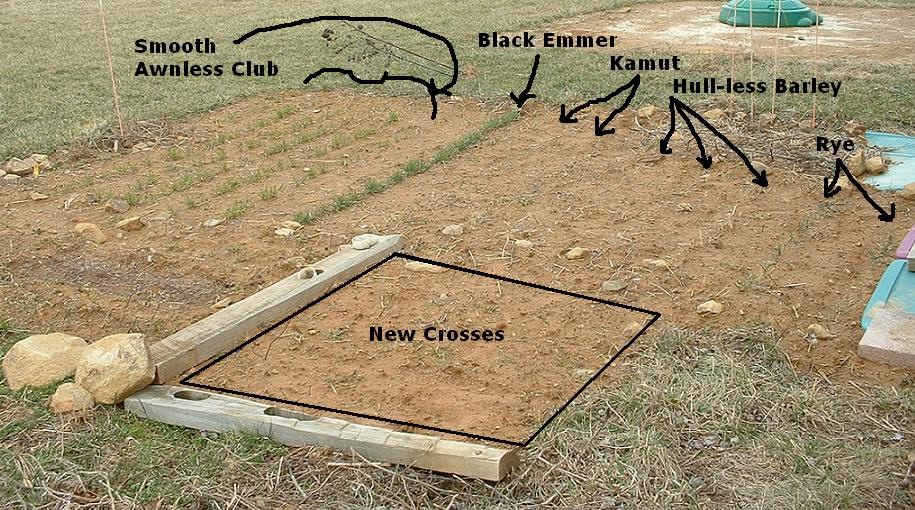 Looks like the 'Kamut' wheat and 'Hulless Barley' have both been winterkilled, but 'Black Emmer', Rye and "Smooth Awnless Club" have done fine once again. The new F1 wheat crosses all are doing well too.


