... growing and hybridizing all kinds of plants in zone 6b Maryland since the 1980's.

Thursday, July 7, 2011

F1 Wheat - 'Smooth Awnless Club' X "Black Emmer"


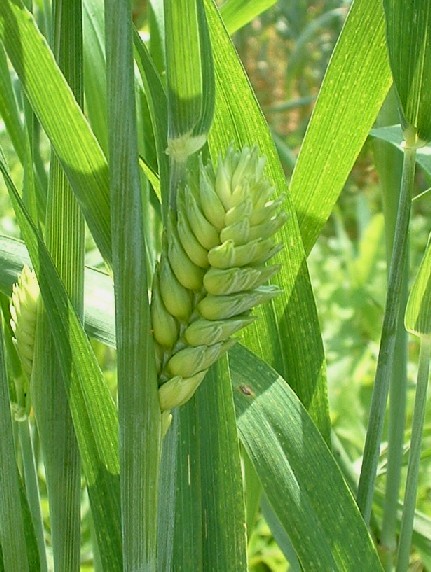
I'm really happy with this cross and think it has incredible potential to generate all kinds of interesting wheats. In my hand are the mama and papa. To the right are several heads of the F1. The mama is a locally adapted club wheat (I call "Smooth Awnless Club") that is derived from 9 generations of selection from a cross I did many years ago of a commercial common bread wheat with 'Pima' club wheat. 'Pima' is a southwest adapted strain that was supposedly introduced by the Spanish missionaries and grown for many years by the Pima. My "Smooth Awnless Club" differs from 'Pima' in having no pubescence on the glumes (seed coverings) and by being much happier to grow here in Maryland. "Smooth Awnless Club" should be a hexaploid, with 42 chromosomes.
The papa, 'Black Emmer' is an awned tetraploid wheat, with 28 chromosomes. It is one of the healthiest and most vigorous wheats I've grown, but it has the major drawback of being a "covered wheat" - it requires quite a bit of processing to extract the seeds, since they don't thresh free of the glumes like most modern wheats.
The pentaploid hybrid shows the dominance of the black glume trait (from 'Black Emmer") and awnlessness and free threshing (from "Smooth Awnless Club") along with an intermediate head shape. Disease resistance was roughly intermediate too, but the vigor was phenomenal. Just as expected from what I'd read about this kind of mixed ploidy cross, the pentaploid F1 are only about 50% fertile. But even so, I'm counting around 30 seeds per head, which should give me a decent sized F2. The future generations should theoretically tend to revert back to hexaploids and tetraploids. So, I'm hoping to maintain at least some of the vigor while selecting for disease resistance and unique free threshing derivatives. Two things I'm hoping to see... an exceptionally disease resistant, black glumed club type with higher carotenoid content in the grain... and a free-threshing, awnless version of 'Black Emmer'.
Aside from this cool F1, I also grew two others this season:
'Black Emmer' X 'Kamut' - (a cross of two tetraploid) - which should also give me an opportunity to get the free-threshing trait into 'Black Emmer'
"Wooly Awnless Club" X spelt - (a cross of two hexaploids) - the mama is a sister strain to "Smooth Awnless Club" and spelt is another primitive "covered wheat.

Friday, June 10, 2011

Bracteata hybrids

The four bracteata hybrids I moved to their new home two years ago, have settled in and started to stretch out. The first is one I've posted about before - nicknamed "Pink Monster". The second is one of its white flowered siblings. The whites would look just like bracteata if you didn't pay any attention to the foliage which shows a lot of influence from the rugosa and palustris grandparents. The pink one tends more toward rugosa, while all three of the whites (while showing influence of both of those species) show more of the matte surface and elongated leaflets of palustris. I've really enjoyed watching these hybrids mature and am working on rebuilding them using a double-flowered rugosa. It'll be along process since I have to get the double-flowered F1 of rugosa and palustris first. Hopefully one of these germinated this Spring.


Thursday, June 9, 2011

Russian Pomegranate

I ordered this Russian pomegranate from "Edible Landscaping" in Afton Virginia. It's supposed to be one of the cold hardiest of the pomegranates. Well, it's survived two winters now here in zone 6b Maryland, which is a whole lot more than I can say for the 'Nana' dwarf pomegranate and '8-Ball' pomegranate that I planted at the same time. What's more it's even blooming this year. I don't know if the season will be long enough to ripen any fruit, but it sure is a pretty flowering shrub even if it doesn't.

'Sweet Scarlet' Goumi (Elaeagnus multiflora)

I'm impressed by this little shrub already. I just purchased it this Spring and it's less than a foot tall, but already it ripened three tasty little berries as a preview of things to come. They're quite a bit bigger than the locally naturalized Autumn Olive (Elaeagnus umbellata) fruits and taste better too. I think this one's going to be a welcome addition to our edible landscaping... fragrant Spring flowers, attractive foliage, tasty berries and a nitrogen fixing shrub as well... I can hardly imagine how productive these bushes must be when they mature.

Thursday, June 2, 2011

'Fragrant Cloud' X Rosa carolina

I had to move this hybrid two years ago and it's finally getting settled in and looks happy now. It was a difficult cross (I tried repeating it unsuccessfully) and happens to be one of my favorites for uniqueness. It's relatively cooperative as a seed parent although last year it refused to accept 'Home Run' pollen. It is the mother of one I call "MR1" (which was from 'Carefree Sunshine' pollen) and also of the 3/4 native seedling I posted here last year (which was from pollen of a Rosa virginiana clone). It's only a once-bloomer but is fairly healthy and has a great fragrance.

Successful F1 Wheats

The first pictures shows a seedhead emerging from one of my stabilized wheat lines (at least 8 generations of selfing) that I call "Smooth Awnless Club". It was derived from a cross I did many years ago of a common bread wheat as seed parent and 'Pima' club wheat as pollen parent. "Smooth Awnless Club" has the typical compacted seedhead architecture of club wheats. In crosses, the seedhead is usually intermediate in length. This makes it relatively easy to confirm hybridity of intended hybrid seedlings.


Last season I used this "Smooth Awnless Club" as seed parent and 'Black Emmer' as pollen parent. I got a total of five shriveled seeds (this cross is between a hexaploid and tetraploid so may be a little more difficult than same ploidy crosses). Now that the seedlings are heading, I see that three are actual hybrids by their more elongated seedheads. Two are apparent accidental selfings. I'm really excited about all of the possibilities that are contained in this match. From what I've read, future generations should start segregating out lines that tend to be either tetraploid or hexaploid. It should be very obvious which are which, because the gene for compact head structure resides on the D genome. This is the group of 7 pairs of chromosomes that make the hexaploids different from the tetraploids. So hexaploid lines should be club type and tetraploid lines should be elongated. 'Black Emmer' is one of the healthiest wheats that I've grown but it is a "covered wheat" - it doesn't thresh free of its seed coverings. Hopefully I can get the disease resistance and vigor of 'Black Emmer' incorporated into some of my locally adapted club lines and simultaneously introgress the free threshing trait into 'Black Emmer' types. [I have another cross setting seeds right now, that should also help in this direction - it's 'Black Emmer' X 'Kamut']


The very bottom picture shows seedheads from a cross of another of my club lines (I call "Wooly Club") with 'Spelt' wheat. "Wooly Club" is derived from the same original cross that gave "Smooth Awnless Club". From "Wooly Club" X 'Spelt' I got four seeds. All four seedlings have headed out with the same obviously hybrid (elongated) seedheads.

Friday, May 27, 2011

Fragrant Columbines

I grew the Himalayan Columbine (Aquilegia fragrans) about 10 years ago and really liked the jasmine scented flowers. Unfortunately the plant just never was happy here. So a few years ago I purchased another plant to try to cross with all of the typical, common, blue-purple Aquilegia vulgaris types that are growing out front. Well, the new plant was just as puny as the first, but luckily I did get it to set a bit of seed from the blue-purple vulgaris pollen before it croaked. There are two of the color forms that the F1 have shown, a near white that is similar to fragrans and a light blue. These F1 are not as powerfully fragrant as Aquilegia fragrans, but they definitely are fragrant. And they're super vigorous! The upper flowers are quite a bit taller than a yardstick (meterstick) - see yardstick hidden in the bottom picture. I've started a small population of F2 to see if I can work back towards more fragrance while maintaining the healthy growth habits.