
Friday, October 19, 2012
Reblooming MTB Iris
The 24 chromosome diploid MTB's (Miniature Tall Bearded irises) don't have a whole lot in the way of rebloom among their ranks. Here's my own addition to that small crowd starting to send up a Fall stalk. It's called 'Cricket Song' and has reliably bloomed both Spring and Fall since 2006, here in Maryland. It has also rebloomed in Tennesee, Kentucky and California now. I'll try to remember to post again when it opens. Greg and Macey McCullough of Iris City Gardens introduced this iris for me with their 2012 offerings. Thanks guys!


Wednesday, October 17, 2012
"Red Clubhouse" strawberry
You might have wondered what happened to these seedlings since I haven't posted about them in a while. They're from "White Clubhouse" (our own everbearing vesca type with runners) pollinated by 'Red Wonder' alpine strawberry. They've been flowering and fruiting all season just like the parents. Of course they all slow down during the heat of the summer, but they're picking back up again now. These are vescas and everbearing but also make so many runners it's just crazy. Not super-productive all at once, but being able to find a few fruits anytime of the growing season sure is nice!


Fall Radishes
I selectively favored keeping the purplish-foliaged seedlings when I thinned this row of 'Long Black Spanish' fall radish. I'm hoping these are the outcrosses to 'Roseheart' which was flowering at the same time. It would be fun to see how the pink flesh trait interacts with the black skins.


Pomegranates
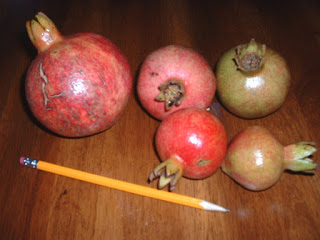
This year's "crop" isn't as big as last season but it's still good to have any at all. And I was successful with two cuttings, so I can get started on making a hedge of these.

Saturday, October 6, 2012
Impatiens Downy Mildew
Well, I've gotten to witness the devastating effects of downy mildew on Impatiens walleriana. Wow, it really lays waste! The second picture was taken about a week ago. Now there's nothing left but the stems. Looks like resistance to this disease is going to have to be a top priority for Impatiens breeders now.


Monday, October 1, 2012
Rosa bracteata X (rugosa x palustris)
Took these pictures while out collecting hips.
Three of the four siblings showing the mounding and spreading growth habit - but keep in mind these haven't really regained full size yet.
 Here's a blurry close-up of the thorns on one.
 Here's the foliage on one that shows a strong influence from palustris.
 The open-pollinated hip harvest - see they really aren't sterile!
 And here are the vicious prickles that I've spent the last two days removing from my finger tips because I stupidly insisted on picking them bare-handed. I wised up and used a leather glove and steak knife to extract the seeds. There was typically only one seed per hip, but quite a few had none and a couple even had 2, 3 or 4. Definitely not super-fertile, but certainly not a dead end either! Maybe next year I might even give hand-pollination a try again.

Three of the four siblings showing the mounding and spreading growth habit - but keep in mind these haven't really regained full size yet.


Subscribe to:
Posts (Atom)