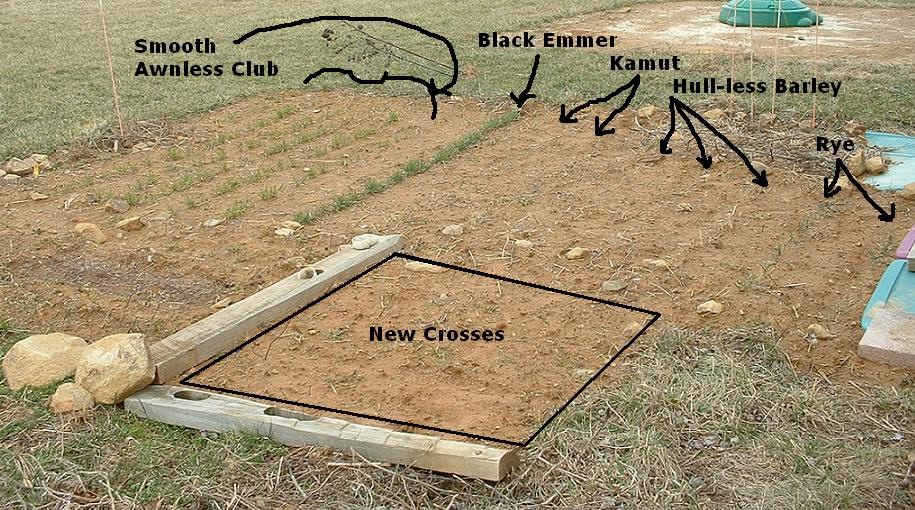
 Looks like the 'Kamut' wheat and 'Hulless Barley' have both been winterkilled, but 'Black Emmer', Rye and "Smooth Awnless Club" have done fine once again. The new F1 wheat crosses all are doing well too.
Tuesday, March 15, 2011
Small Grains Update
Looks like the 'Kamut' wheat and 'Hulless Barley' have both been winterkilled, but 'Black Emmer', Rye and "Smooth Awnless Club" have done fine once again. The new F1 wheat crosses all are doing well too.

Iris purpureobractea seedling with red leaf margins
Here's a better close up of that seedling with the red-margin trait (posted earlier in March).


Below is its papa who carries the red-margin trait (sorry about the messy picture), practically obscured by purple pigmented foliage bases. This one is 1/4 Iris suaveolens var. rubromarginata, which is the original source of the red-margin trait.

Saturday, March 5, 2011
Iris purpureobractea seedlings
It's just about time for Spring and it's a good time to see foliage pigmentation in bearded iris seedlings. Here are two purpureobractea seedlings that are showing some red/purple leaf margin color. Actually this red-margin trait is derived from the pollen parent which is 1/4 Iris suaveolens var. rubromarginata. - a tiny dwarf species known for that pattern of leaf pigmentation.
Below is a sibling with less dramatic leaf margins but considerable basal pigmentation - known as "PBF" (purple based foliage) among iris enthusiasts. The PBF is also primarily coming from the pollen parent. This particular seedling is looking like it has considerable hybrid vigor, evidenced by the broad (at least 1 inch already) foliage on this very young plant. These are presumably diploids (with 24 chromosomes); foliage this broad is more typical of tetraploid Tall Beardeds.

Sunday, January 2, 2011
Glossy Kale-ards

Sad looking right now, but I think they'll rebound when Spring comes. The encouraging parts are that they're showing quite a bit of variability and at least that one purplish one (at the bottom) is about as happy as the weedy mustard (bottom right). These are glossy leaf selections descended from a mixture of Dwarf Blue Curled Scotch Kale, Green Glaze Collard Greens, and an ornamental purple/red cabbage/kale. In 2010, I interbred this population with Tuscan kale. Now with all this variability to work with, I need to do a large planting and really start to put some heavy selective pressures on them (for winter-hardiness, insect resistance, etc.) The latest insect plague has been Harlequin bugs. Seeing the damge that they've done, it sure would be nice to select for more resistance to those.
Winter Small Grains


Just a little comparison of the damage suffered after being frozen for extended periods of time without any snow cover. Keep in mind that the rye was planted very thinly and the 'Black Emmer' more thickly than the rest but even so here's how I would rank these five (best to worst cold tolerance)... rye was best as expected; Smooth Awnless Club and Black Emmer both did remarkably well; Hull-Less Barley and Kamut suffered quite a bit, as expected (since these seem to be more often grown as Spring sown crops).
Friday, December 17, 2010
Rooting rose cuttings
I've always had difficulty getting cuttings to root but look at these nicely calloused cuttings. One's already sending out roots. I followed the damp newspaper method described at the Rose Hybridizer's Forum. Thanks for sharing that tip George!
See link below for details.
http://www.rosehybridizers.org/forum/message.php?topid=31884#31884

See link below for details.
http://www.rosehybridizers.org/forum/message.php?topid=31884#31884

Friday, November 19, 2010
Viola X cooperrideri F2
 Here's that F2 seedling from the cross of Viola striata X Viola walteri that I posted a few weeks back. The picture isn't great, but at least you can see how well it's blooming today (Nov.19) - I'll have to move this one to a better spot and try to collect seed, so I can select for even earlier Fall bloom.
Subscribe to:
Posts (Atom)