... growing and hybridizing all kinds of plants in zone 6b Maryland since the 1980's.

Wednesday, September 26, 2012

Rosa palustris gland hairs

I've mentioned before how this clone of Rosa palustris has glandular scented flowerbuds (and hips), but I don't know if I've stressed just how glandular it is. Check out the sticky droplets on these ripening hips. I collected a few so I can send seeds to someone and this is what my fingers looked like afterwards. I wish I could post the smell!
Only trouble is, it didn't wash off with soap and water. I ended up having to use rubbing alcohol to get the "glue" off.
But now maybe you can see why I wanted to see what would come from crossing this with glutinosa - another sticky, strongly-scented species.

Hibiscus grandiflorus again

First bloom of the year opened the night before last [Sept.24] on Hibiscus grandiflorus. Here's the second bloom opening last night (first picture) and still open this morning (second picture). I found a one stray late bloom on 'Old Yella' and another on 'Blue River II' and kept them in the refrigerator for a week or two to use them to pollinate grandiflorus. The third picture shows how 'Blue River II' has already matured most of its pods. 'Moy Grande' in the fourth picture has even already dropped all of its foliage and is going dormant. The last picture shows how well the new hybrid seedling has grown - it's the one from 'Blue River II' x grandiflorus, that I worked so hard to get last year. I'm considering trying to root a piece just as insurance in case something happens to this seedling.


Wednesday, September 19, 2012

Sweet Corn backcross ear

Now that it's drying down, you can more easily see how there are about 50:50 normal kernels to shriveled/sweet kernels. Last year, I detassled 'Japonica Striped Flint' and pollinated in by our own colorful sweet corn population (of very mixed ancestry). I planted the seed from those ears this year and detassled the resulting F1 plants. When pollinated by our colorful sweet corn again, the ears look like the picture. The sweet kernels will be what we'll plant nest season. From that point on, all the kernels on all the ears should be sweet. Simple as that - a significant amount of 'Japonica Striped Flint' influence can be brought into our sweets. Even though none of the hybrid seedlings has expressed the recessive striped foliage gene, I'm betting a few of these shrunken kernels are carriers and will allow me to recover that trait in another generation.

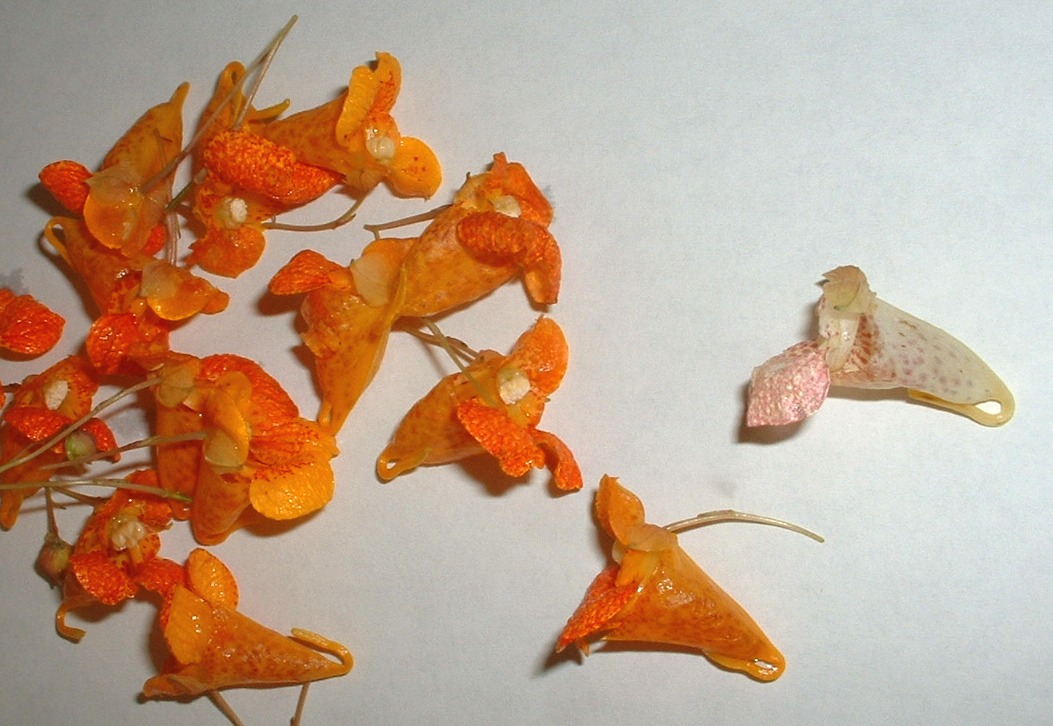
Jewelweed (Impatiens capensis) pale form

This is the second year I've seen a couple of these pale forms among the normal orange jewelweeds. The red spotting is still the same but it's over a pale yellow (almost white) background so it has an overall pink look. There were only two plants this year. I've collected a dozen seeds so we can try to germinate them in pots next Spring.

Rosa palustris

Here's how the swamp rose (Rosa palustris) currently looks - it hardly loses a leaf all season! I collected this clone when I was just a kid, from a boggy area near where I grew up. This area had visible standing water for most of the winter months and was still relatively moist throughout the drier summer months. Yet, it withstands upland drier conditions pretty well too. Hips should be ready to shell out and send soon [Simon ;0)]. I'll e-mail you for shipping details.

Hazelnut Harvest 2012

The American Hazelnuts bushes have been harvested. We'd already eaten a few but the remaining total is about 9 pounds (in the shell) - compared to the mere plateful last year. And from what I've read about typical yields, and considering that most of the bushes are still pretty small (and had no nuts or only a few), I think we're going to be swamped with nuts in a few years. We've got 44 bushes and average yield is supposed to be about 1.5 pounds/year. So 60-70 pounds shouldn't be too surprising! Having hand-husked these 9 pounds, I think we're going to have to set up something like Don Price's Bucket Husker (found plans by Googling) to deal with them in the future. It would be great to have some kind of sheller too, but that doesn't bother me as much because we can just shell them a little here, a little there, as we use them.
These American Hazelnuts are a little small compared to the European type sold in the grocery stores but they're still pretty tasty. We found a method for de-skinning the shelled nuts by boiling in 2 cups of boiling water with 3 TBSP baking soda added, for a few minutes. The water turns black and the nuts can be skimmed out into cold water where the skins will just slip right off. The skins don't have to be removed, but can be a little bitter. Anyway, after skinning and drying, we roasted for 15-20 minutes at 300 Fahrenheit. They sure were good!


Some rose seeds

Some seeds harvested yesterday... the first plate is from two hips of Rosa glutinosa that resulted from pollen of Rosa fedtschenkoana - should give some interesting scented-foliage offspring. The second plate gives an idea how "fertility-challenged" my F1 (glutinosa X palustris) hybrid seedling is. These seeds (around 30) came from about two dozen open-pollinated hips. Most of these hips contained only one single seed. Just a few had two, and one hada whopping four. Actually most of the hips had aborted soon after petal drop, presumably because they didn't have any seeds at all. So... I wonder who the pollen parent of these seeds might be and what ploidy (and fertility they'll have). Rosa glutinosa is supposed to be a Caninae type pentaploid and palustris is a diploid. The F1 should be pentaploid too, but whether or not the Caninae type meiosis held up in the hybrid could make for some unusual happenings.