Two newer projects:
And a short row of pearl millet ripening. I think that this variety is intended to be a hay and pasture type, but I couldn't help but try it anyway and maybe select better grain types from it. Seems to be doing fairly well.
... growing and hybridizing all kinds of plants in zone 6b Maryland since the 1980's.
Friday, September 16, 2011
Hybrid Tomatoes Again
Here are a few more pictures to go along with the September 1, 2011 post about those hybrids from the cross of 'White Wax' X hirsutum derivative. First picture shows mama, papa and offspring. Second picture shows close-up of the hirsutum derivative, so you can see the purple-black anthocyanin pigments outlining a star shape where the calyx had been. This fruit would turn a little bit yellowish but still basically green when it fully ripens. I had to pick it a little early for the picture. The purple-black pigment doesn't disappear on ripening. The third picture shows a close-up of the offspring. The start pattern still shows where the faint purple pigment overlaid on the yellow skins looks like a brownish blush. That dirty looking blush almost covers the upper half of the fruit.
Wednesday, September 14, 2011
Hibiscus grandiflorus opening
Well, the lone bud that resulted from the trashcan trickery is opening this evening. By 6:00 PM, it was open enough to see completely inside. Severe thunderstorms were starting up, so I went ahead and picked it and brought it inside. I got a nice picture of it open [with a little persuasion] and went ahead and refrigerated at least half of the pollen. The rest I plan to use in the morning on some extra late blooms of 'Blue River II' - a pure white hardy Hibiscus moscheutos type hybrid. I had to remove ALL of the normal season blooms and buds from 'Blue River II' to force it to regrow and generate these flowerbuds from laterals that wouldn't normally have bloomed. If left to its own devices it would be dropping mature seeds by now. With all of this trickery and coersion, maybe I'll finally get some grandiflorus hybrid seedlings. By the way, the grandiflorus flower was scented just like always. It reminds me of some scent from childhood but I haven't been able to place it yet. It's sort of like a less intense version of the scent of certain daffodils/Narcissus.
Lycoris radiata - Red Spider Lily
Just moved these bulbs about two weeks ago and I'm glad I didn't wait any longer. They sprouted up immediately. I moved some Sternbergia bulbs at the same time and they're just starting to peek a little.
Wednesday, September 7, 2011
Tomato: Lycopersicon pimpinellifolium X 'Angora' F2
I can't take credit for starting this line - many years ago,
some little bee must have done the original cross. The last time I had grown
red currant tomatoes was some time back in the mid 1990's. So last year (2010),
not really expecting my old seeds to be viable, I gave them a try anyway. To my
total surprise, I think nearly every seed germinated. Among the seedlings was a
wooly one - obviously from pollen of the 'Angora' tomatoes I'd also grown so
many years ago. In addition to having wooly foliage, the fruit size was
definitely bigger than the pea-sized currant tomato siblings. Even so, the
fruits were slightly smaller than an average cherry tomato. The fruits pictured
are from F2 seedlings planted this year. I intentionally chose these three
fruits because they were larger than the rest. They have a different shape too
- broader than tall. Two of these fruits had three cells (seed compartments) and
the other one had four cells. They all ripen to a intense, dark red and have
pretty good flavor. I like the idea of incorporating the currant tomato flavor
and disease resistance into my tomato lines but the reduction in fruit size is
not so easy to breed back out. Maybe some selection for size in this
"wooly pimp" [garden name] line would be a good idea before I cross
it with my others. Meanwhile I'll just try to appreciate it for being a good
cherry tomato.
Thursday, September 1, 2011
Tomato hybrids: 'White Wax' X F4 hirsutum derivative
These are fruit from one of this years hybrid tomato seedlings. It’s a seedling derived from ‘White Wax’ tomato that I grew last year and pollinated by a 'Brandywine' x hirsutum derivative (F4) that showed considerable purple-black pigmentation. Lycopersicon hirsutum (currently reclassified as Solanum habrochaite by taxonomists) is a green-fruited wild South American species. This F4 derivative line had a fairly small fruit with a green-yellow ripe background color and not-so-great flavor. It took after hirsutum much more than 'Brandywine'. My aim was to get the purple-black pigment of this seedling into a larger, better tasting, white background fruit (hence the ‘White Wax’ seed parent in the cross). So far these three fruits represent the best stepping stones in that direction. They are showing at least a little bit of the purple pigment and MUCH better flavor and size. Hopefully the next generation from selfing, will have a few white revertants that also tend toward ‘White Wax’ in size and flavor, while still expressing some of that purple-black pigment. Fertility seems to have improved already too.
The first image shows a slightly unripe fruit, so that you can see that the green shoulders and purple-black speckling are two different traits. [Someone had once insisted to me (without seeing in person) that what I was seeing was just chlorophyll] Often the green shoulders and purple speckling will occur in the same area of the fruit surface, but as the fruit ripens the green will disappear while the purple does not. On this particular fruit shown, the purple and green overlap but not completely. So the brownish blush in the center of the photo is the purple pigment (it looks brownish when overlaying a yellow background) while the green shoulders are on the left.
The second image shows two completely ripe fruits. The purple speckles of pigment on these are facing the camera, all around the glare/shine spots. This purple blush is definitely variable and a lot of the variability seems to be temperature and sunlight dependent, so I'll post pictures of more intensely pigmented fruits later in the season if they appear. I'll also try to get some pictures posted of the F4 hirsutum derivative that fathered this hybrid.
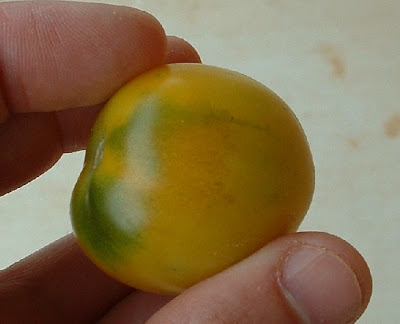
The first image shows a slightly unripe fruit, so that you can see that the green shoulders and purple-black speckling are two different traits. [Someone had once insisted to me (without seeing in person) that what I was seeing was just chlorophyll] Often the green shoulders and purple speckling will occur in the same area of the fruit surface, but as the fruit ripens the green will disappear while the purple does not. On this particular fruit shown, the purple and green overlap but not completely. So the brownish blush in the center of the photo is the purple pigment (it looks brownish when overlaying a yellow background) while the green shoulders are on the left.
The second image shows two completely ripe fruits. The purple speckles of pigment on these are facing the camera, all around the glare/shine spots. This purple blush is definitely variable and a lot of the variability seems to be temperature and sunlight dependent, so I'll post pictures of more intensely pigmented fruits later in the season if they appear. I'll also try to get some pictures posted of the F4 hirsutum derivative that fathered this hybrid.
Strawberry Crosses
I think I’ve figured out a method that works best for me for doing strawberry crosses… I’ve been looking for freshly opened flowers with plump yellow anthers. I pluck these off with tweezers onto a dark and shiny surface. After about an hour or so, they’ll shrivel up and release a bunch of pollen. I pushed them around a little bit with the tip of the tweezers (or my finger) to knock some pollen loose and then just used my fingertip to apply the pollen to the central greenish-yellow part of a newly opened flower. In this case, I’ve been putting pollen of the “Clubhouse” strawberry (what we’ve started calling our white/yellow-fruited, everbearing, vesca type) onto flowers of ‘Red Wonder’ alpine strawberry. Any seedlings with runners should definitely be hybrids. All of the seedlings should be red-fruited and all should be everbearing.
The first image shows anthers freshly plucked from two flowers. The second image shows how even newly forming runners of "Clubhouse" are flowering.
Subscribe to:
Posts (Atom)