... growing and hybridizing all kinds of plants in zone 6b Maryland since the 1980's.

Sunday, November 11, 2012

Deer and Fall radishes (sounds like dinner)


A few of the "reasons" why its always such a gamble trying to grow anything around here - also, why  I don't think I'll ever be breeding for thornlessness in roses. I just planted some relatively unarmed roses ('Commander Gillette',  'Basye's Legacy' and 'Basye's Blueberry' that I got from Burlington Rose Nusery). 'Basye's Blueberry' has already literally been grazed to ground level! I'm definitely going to have to cover these with cages if I expect them to have any chance of getting started.
The lush line of green at their feet is a row of 'Long Black Spanish' storage type radishes (with F1 hybrids among them from intercrossing with 'Roseheart' pink-fleshed radish). The deer were browsing these when they were just starting out but thankfully have left them alone when they got a little bigger. 

Tuesday, November 6, 2012

Pomegranate seeds

I tried planting some of the Russian pomegranate seeds directly in the ground last Fall and didn't get a single seedling. I didn't know if it was the cold or because I dried them before planting. Whatever the case, it was time to try something different. So I put the fresh seeds with any leftover pulp still attached into a zip-lock and let it ferment a couple of days. I then rinsed the rotted pulp off with a kitchen sprayer (in a wire mesh strainer). Back into the bag for a couple more days wet fermenting and another rinse. Yesterday I noticed that one seed had started to split and a root was peeking out, so they all went into potting soil in the basement. I'll let you know how it works this time. Here are the clean wet seeds right before planting.
 

'Cricket Song' reblooming MTB iris

'Cricket Song' reblooming MTB iris still in bloom this evening, after sparkly-frosted grass this morning.

Saturday, November 3, 2012

Rosa rugosa X xanthina

Adam's questions prompted me to look up these old pictures and post about this old hybrid.
Adam asked "Could you tell me more about this cross. Did you get a lot of seedlings out of this cross or just a few? What rugosa did you use? Have you breed anything out of it or did it turn out to be sterile?"
The rugosa I used was just an unnamed typical single-flowered, magenta/fuschia colored type. I always thought of it as "generic" rugosa. It's the same rugosa I've used as parent of pretty much all of my rugosa species crosses. Rosa xanthina pollen gave me big hips with lots of seeds and good germination. [A few years later I tried using the similar Rosa primula on the same rugosa and got no hips set at all.] All of the seedlings I raised to maturity were so similar that I couldn't tell them apart. They often  have a faint brushing of pink on the edges of the petals while still in bud, but you can't see any of this in the open flowers. The old [2004] photos below are kind of washed out by the bright sunlight but almost give you an idea of the color - a pale butter yellow. The scent is moderately strong and reminds me of Scotch rose scent. Actually I've always thought that this hybrid seems to want to follow Hurst septet theories - it has a lot of the characteristics of Rosa piminellifolia.
As for prickliness, the bottoms of the plant are fairly well armed but the prickles nearly disappear on the upper parts of the plant. Some of the tip top growth is nearly thornless.
As you might expect, this hybrid has never set even a single hip. It does make a little pollen and years ago I collected a bunch and used it for backcrossing onto the rugosa parent. I got hips and seeds but never germinated them (my fault, not the seeds). So as infertile as it seems, there is hope that it isn't a complete dead end. Once upon a time I also had what I believe was a partially converted branch (using trifluralin to induce polyploidy). The leaflet shape and substance had changed (rounder, thicker and crinkled) and the three flower buds I got to see were chunkier also. Sadly, that branch died back from some kind of canker shortly after flowering.
I dug a couple suckers from the original plant, still growing at my parents' house and planted them here last year. They're settling in nicely but haven't built up very much yet. I'll try to get accurate color pictures whenever it blooms.


Thursday, November 1, 2012

V3 - Rosa virginiana

Sadly I don't think this clone survived the move. It was labeled "V3" when I received it in an exchange of native tetraploid clones [with Roger Mitchell if I'm remembering right???] many years ago. This one was the pollen parent that I used on my 'Fragrant Cloud' X Rosa carolina hybrid to give me the one I call "3/4 Native". This year I collected a boatload of open-pollinated seeds from "3/4 Native" hoping that at least a few, by some crazy luck of the draw, might germinate and turn out to be repeat bloomers.

Rosa glauca x xanthina

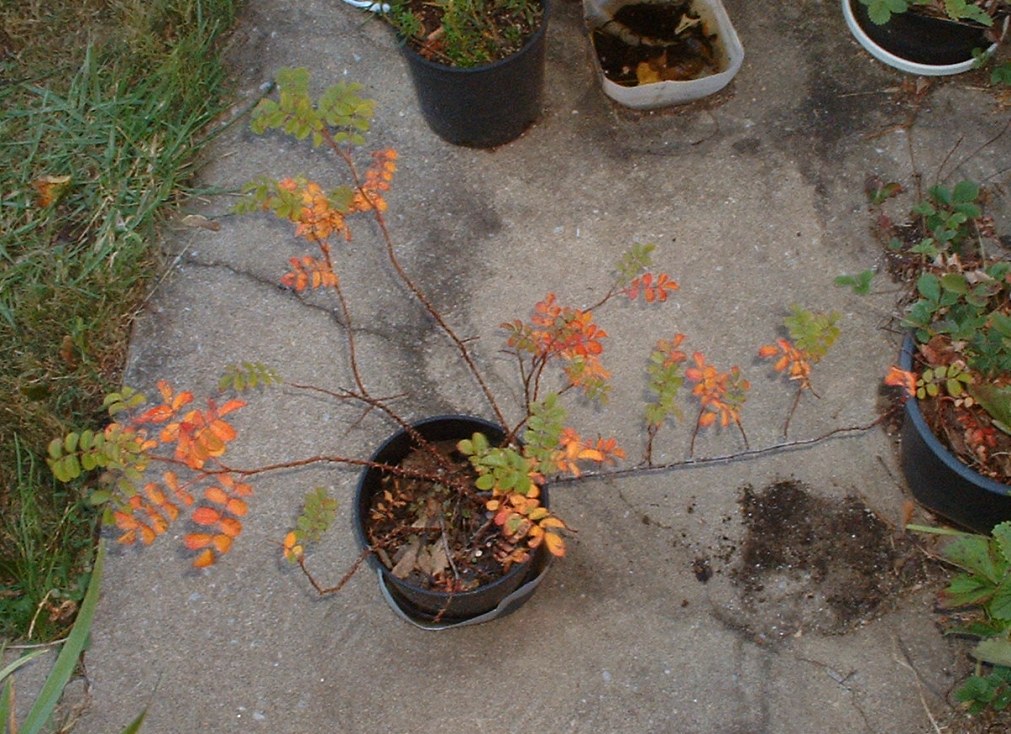
Had chuckle when I saw this old photo. I had great hopes for this cross. I envisioned a salmon/peachy flower over glauca-type greyish-purple foliage. Wouldn't that have been nice?
Unfortunately, this combination of species wasn't very successful at all. The weak and runty seedling never flowered even once in all the years I had it (at least 6 or 7) and it didn't even really build up any. In the picture, you can see the stumps of old growth that died back. I eventually tried it in the ground and that was the end of it.

Maize X Gamagrass

I was looking for another old picture and happened to run across these ones of a hybrid I raised from pollen of gamagrass (Tripsacum dactyloides) on 'Strawberry Popcorn'. It suffered miserably indoors over each winter so I was never able to get it to flower. Eventually I lost it. If I knew back then what I know now, I'd have tried the inverted trashcan trick on it. One of these days I'll have to repeat this cross. First picture shows the seedling in early September of 2003. Second picture shows all of the rooted tillers I got from it a month later in October 2003. I tried wintering these indoors and the third picture shows how the lone survivor looked in September 2004 after having spent the growing season in the ground.